Few cars carry the weight of legend quite like the BMW E30 M3. Born not from a marketing brainstorm but from the brutal, uncompromising demands of Group A touring car racing, the original M3 was a homologation special in the purest sense — a road car built only because the rulebook required BMW to sell a minimum number to go racing. What started as an engineering necessity became, over three decades later, the most revered and valuable production BMW M car in history.
The BMW E30 M3 is the car that established the M3 nameplate as sacred. It is the reason enthusiasts still argue over the merits of naturally aspirated four-cylinder engines, box-flared fenders and steering that talks back to you. And it is why pristine examples — particularly the ultra-rare Sport Evolution — now change hands for well over a million dollars at major auctions.
This is the complete story of how a race car in disguise became one of the most important vehicles BMW ever built, and why its DNA still runs through every M car sold today.
Why the E30 M3 Existed: Group A Homologation
In the mid-1980s, the FIA's Group A touring car regulations dominated European and global motorsport. To compete, a manufacturer had to build and sell at least 5,000 road-going examples of the car within a 12-month period — with additional "Evolution" specials permitted in batches of 500 to homologate specific aerodynamic and mechanical upgrades.
BMW Motorsport GmbH, the division that would later become BMW M, saw an opportunity to beat Mercedes-Benz's 190E 2.3-16 and Ford's Sierra Cosworth on the track. The solution was to take the humble, well-balanced E30 3 Series and transform it into a purpose-built weapon. Crucially, the M3 was never a lightly warmed-over 3 Series. Of the entire bodyshell, only the hood, roof and (partially) the trunk lid were shared with the standard car.
Everything else — the flared fenders, the steeply raked rear window, the taller trunk lid and that unmistakable rear spoiler — was engineered specifically to make air flow cleanly over a race car. This was aerodynamic homologation made visible, and it gave the E30 M3 a silhouette instantly distinguishable from every other 3 Series on the road.

The Heart of the Beast: The S14 Engine
The E30 M3's soul is its engine. The S14 was a 2.3-liter (later 2.5-liter) naturally aspirated inline-four featuring a 16-valve cylinder head derived directly from the legendary M88 straight-six that powered the BMW M1 supercar. BMW Motorsport engineers essentially lopped two cylinders off that racing six and mated the head to a robust iron block related to the M10 four-cylinder.
The result was a screaming, high-revving four that felt like nothing else in the segment. Individual throttle bodies, a motorsport-grade cylinder head and an appetite for revs gave the S14 a character that turbocharged rivals simply couldn't replicate.
| Variant | Displacement | Approx. Power | Years |
|---|---|---|---|
| M3 (early, catalyst) | 2.3L S14 | ~192 hp | 1986–1990 |
| Evolution II | 2.3L S14 | ~217 hp | 1988 |
| Sport Evolution | 2.5L S14 | ~238 hp | 1990 |
Power figures may sound modest by modern standards, but with a curb weight of roughly 1,200 kg (around 2,650 lbs) and a chassis tuned by racing engineers, the E30 M3 delivered performance and engagement that remains benchmark material. You can explore the full engine and chassis lineage in our BMW DNA database.
The E30 M3 Evolution Family Tree
Part of what makes the E30 M3 so collectible is the dizzying array of special editions BMW produced to keep pace with evolving Group A regulations. Understanding these variants is essential for any serious collector.
Evolution I and Evolution II
The first Evolution (often called Evo I) arrived in 1987 with subtle aerodynamic tweaks and a lighter approach. The Evolution II followed in 1988 with a more powerful S14, revised aerodynamics including a deeper front splitter and larger rear wing, and lightweight components. Roughly 500 of each were built for homologation purposes.
The Sport Evolution (Evo III)
The crown jewel is the 1990 Sport Evolution — commonly called the Evo III. Displacement grew to 2.5 liters, power climbed to approximately 238 hp, and the aero package was sharpened with adjustable front and rear wings. Only about 600 were built, and many were finished in the iconic Brilliant Red or Jet Black with red or black accents. These are the cars that command seven-figure prices today.
Special and Convertible Editions
- M3 Cecotto / Ravaglia: Named after touring car drivers Johnny Cecotto and Roberto Ravaglia, these limited editions featured unique trim and equipment.
- Europameister: A celebration edition marking BMW's European touring car championship success, finished in Macao Blue.
- M3 Convertible: Hand-assembled in small numbers, the rare drop-top E30 M3 is among the most exclusive variants of all.
Verifying the authenticity of these editions is critical, as clones exist. Checking original option codes against build records — something you can research through our option code vault — helps separate genuine cars from tribute builds.
Motorsport Dominance: The Winningest Touring Car
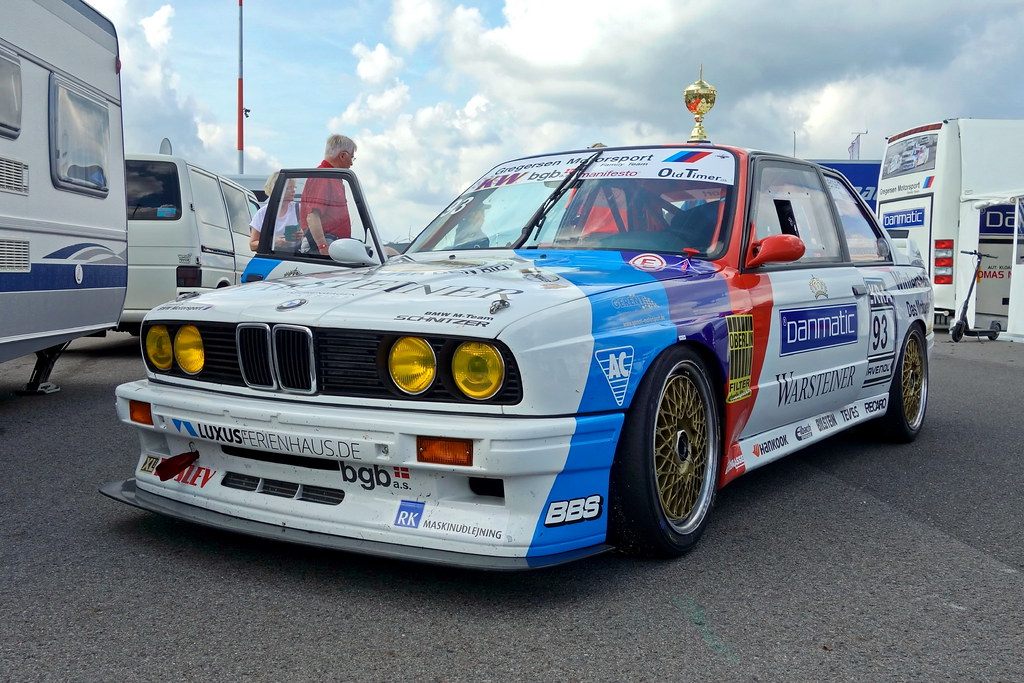
The E30 M3 didn't just qualify for racing — it utterly dominated it. Across the DTM (Deutsche Tourenwagen Meisterschaft), the World Touring Car Championship, the European Touring Car Championship, the British Touring Car Championship and countless national series, the M3 became the most successful touring car of its era.
Highlights of its competition record include:
- The 1987 World Touring Car Championship title with Roberto Ravaglia.
- Multiple DTM championships throughout the late 1980s and early 1990s.
- Overall victories at endurance classics including the 24 Hours of Nürburgring and the Spa 24 Hours.
- Countless national touring car titles across Europe and beyond.
This motorsport pedigree is not marketing gloss — it is the entire reason the car exists. Every flare, vent and wing was justified by lap time, and that authenticity is precisely why enthusiasts revere the E30 M3 above nearly all other M cars.
From Used Bargain to Million-Dollar Classic
For years, the E30 M3 was an attainable enthusiast car — a used performance BMW you could buy for a reasonable sum and enjoy on weekends. That era is firmly over. As appreciation for analog, naturally aspirated driver's cars has surged, so too have E30 M3 values.
Today the market breaks down roughly as follows:
| Variant | Approx. Value Range |
|---|---|
| Standard M3 (driver-quality) | $60,000–$100,000+ |
| Standard M3 (concours) | $120,000–$200,000+ |
| Evolution II | $250,000–$450,000+ |
| Sport Evolution | $500,000–$1,000,000+ |
Values shift with condition, provenance, originality and mileage, so treat these as approximate ranges rather than fixed prices. The very best documented Sport Evolutions have crossed the million-dollar threshold at major auctions, cementing the E30 M3's status as a blue-chip collectible. If you're actively shopping, our M marketplace is a good place to gauge current listings.
The E30 M3's Enduring Legacy
The E30 M3 didn't just launch a nameplate — it defined what an M car should be. Its formula of lightweight construction, motorsport-derived engineering, high-revving naturally aspirated power and near-perfect balance became the template that BMW M has chased ever since.
That legacy still resonates today. As BMW transitions toward electrification and heavier, more powerful M cars, enthusiasts increasingly look back to the E30 M3 as the purest expression of the brand. The ongoing debate over whether the manual transmission has a future — explored in our feature on the future of manual BMW M cars — is itself a reaction to the analog magic the E30 established.
Meanwhile, BMW's design language continues to evolve dramatically, as seen in our coverage of how the Neue Klasse is redefining BMW design. Yet no matter how far the brand advances technologically, the box-flared silhouette of the E30 M3 remains the benchmark against which every new M car is quietly measured. And as questions swirl around how modern performance BMWs will hold their value over time — a topic we tackle in our analysis of BMW EV depreciation and resale values — the E30 M3 stands as proof that the greatest driver's cars only grow more desirable with age.
Buying an E30 M3: What to Know
If the dream of E30 M3 ownership is within reach, approach any purchase with rigor. Key considerations include:
- Authenticity: Confirm the car is a genuine M3 and not an E30 320i converted to look like one. Verify the S14 engine, unique bodyshell and correct VIN.
- Rust: Inspect the strut towers, floor pans, sunroof surround, and rear arches carefully. Corrosion repair on a 30-plus-year-old shell is costly.
- Engine condition: S14 rebuilds are expensive. Budget accordingly and prioritize documented service history.
- Provenance: Special editions and race history dramatically affect value — but only when properly documented.
Do your homework, buy the best example you can afford, and remember that the cheapest E30 M3 is almost never the least expensive car to own.
Conclusion
The BMW E30 M3 story is a rare case of engineering necessity producing an all-time icon. Conceived purely to win on the track, it succeeded beyond anyone's expectations — and in doing so created a legend that has only grown with time. From homologation hero to million-dollar classic, the E30 M3 remains the definitive statement of what makes an M car special: purpose, balance, and an uncompromising connection between driver and machine.
Whether you aspire to own one or simply admire it from afar, the E30 M3 endures as the beating heart of BMW M's identity — and the standard by which every performance BMW, past and future, will forever be judged.