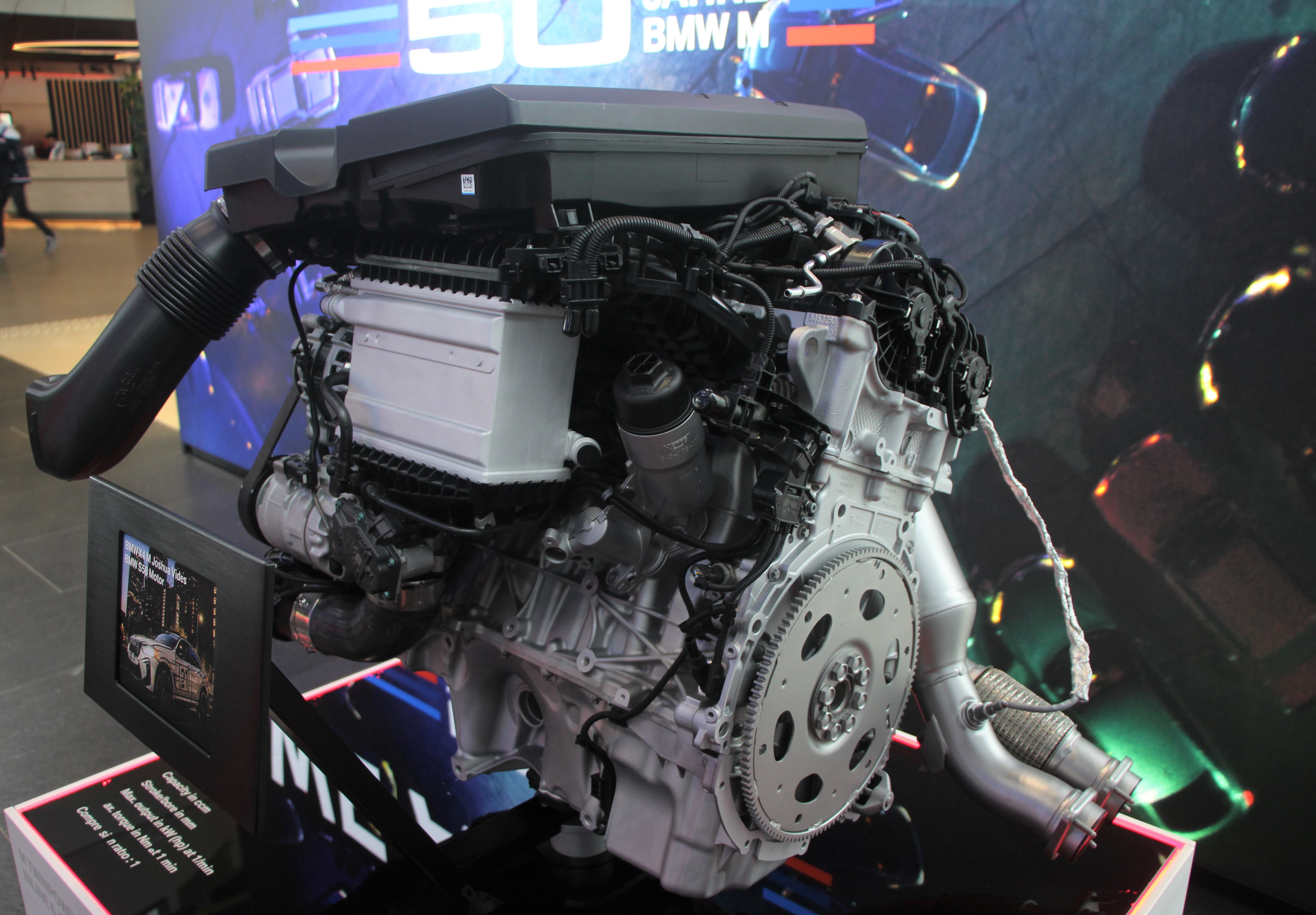
When BMW M unveiled the S58 in 2019 beneath the hood of the X3 M and X4 M, few outside engineering circles grasped just how significant the engine would become. Today, the BMW S58 powers the entire modern M performance six-cylinder lineup — the G80 M3, G82 M4, G87 M2, X3 M and X4 M — and has quietly rewritten the rulebook for what an M engine can do. It combines the visceral character of BMW's legendary straight-sixes with the kind of forced-induction muscle that would have seemed fantastical a generation ago.
The debate over the greatest BMW M engine has traditionally centered on naturally aspirated icons: the S14 in the E30 M3, the screaming S54 of the E46 M3, or the exotic S65 V8 and S85 V10. But the S58 has entered that conversation on merit. It produces more power, more torque, and does so with a bandwidth and tunability that its predecessors simply cannot match. For enthusiasts weighing whether to buy into the current M generation, understanding this engine is essential.
In this BMW M performance deep-dive, we'll break down the S58's architecture, dissect its power delivery, examine its reliability record, and make the case for why it may be the finest M engine ever built.
From B58 Roots to S58 Reality
The S58 is derived from BMW's exceptional B58 modular inline-six — the same engine family found in the M340i, Z4 M40i and Toyota Supra. But calling the S58 a "tuned B58" undersells the transformation. BMW M engineers redesigned the block architecture, cylinder head, cooling, and forced-induction system to handle dramatically higher thermal and mechanical loads.
Key differences from the B58 include:
- A closed-deck engine block (versus the B58's open-deck design) for far greater rigidity and boost tolerance
- A 3D-printed cylinder head core — the first of its kind in a series-production M engine — enabling coolant channels impossible with conventional casting
- Twin mono-scroll turbochargers replacing the B58's single twin-scroll unit
- Forged crankshaft and reinforced internals rated for sustained high-rpm abuse
- Dual fuel-pump system and higher-pressure direct injection
That closed-deck block is the headline story. It's what separates a strong performance six from a true M-grade competition engine, giving the S58 the structural integrity to run boost pressures and cylinder pressures that would distress a lesser design.
The Numbers: What the S58 Delivers
Displacing 2,993 cc (3.0 liters), the S58 is a twin-turbocharged inline-six that has appeared in several states of tune. Output has grown across variants and model years as BMW has refined the calibration.
| Application | Power (approx.) | Torque (approx.) |
|---|---|---|
| X3 M / X4 M (base) | 473 hp | 442 lb-ft |
| X3 M / X4 M Competition | 503 hp | 442 lb-ft |
| G80 M3 / G82 M4 (base) | 473 hp | 406 lb-ft |
| M3/M4 Competition | 503 hp | 479 lb-ft |
| M3 CS / M4 CS | 543 hp | 479 lb-ft |
| G87 M2 | 453–473 hp | 406 lb-ft |
For context, the last naturally aspirated S65 V8 in the E90/E92 M3 produced roughly 414 hp. The S58 in Competition trim makes over 500 hp from three fewer cylinders and a smaller displacement — while returning better fuel economy and emissions. That's a generational leap in efficiency and output density.
You can verify the exact engine and specification of any modern M car through our chassis and engine DNA database, and decode the build details of a specific car via the VIN decoder.
Why the S58 May Be the Best M Engine Ever Made
1. Unmatched Power With Real Character
The knock against turbocharged M engines has always been character — that the artificial swell of boost can't replicate the linear, spine-tingling rush of a high-revving naturally aspirated six. The S58 answers that criticism better than any M engine before it. Its mono-scroll turbos spool quickly, delivering a broad, muscular torque plateau, yet the engine still pulls with genuine appetite toward its 7,200 rpm redline. It doesn't die at 5,500 rpm like many turbo motors; it keeps building.
2. Extraordinary Tuning Headroom
Thanks to that closed-deck block, forged internals and robust cooling, the S58 is a tuner's dream. Simple ECU flashes routinely push output past 600 hp on stock hardware, and built examples have exceeded 1,000 hp. No previous M engine offered this combination of factory strength and aftermarket potential. The S54 and S65 were glorious, but they were near their limits from the factory.
3. Track Durability
The S58 was engineered for sustained abuse. Its oil supply system is designed to maintain pressure under high lateral loads, and the 3D-printed head core provides superior heat management — critical for repeated lapping at circuits like the Nürburgring, where BMW M develops and validates these cars. The G82 M4 CSL, running a version of this engine, lapped the Nordschleife in the low 7-minute range, underscoring how well the S58 endures track conditions.

4. Versatility Across the Lineup
Few M engines have anchored such a broad portfolio. The S58 powers a compact coupe (M2), a sports sedan and coupe (M3/M4), and two performance SUVs (X3 M/X4 M) — in rear- and all-wheel-drive configurations, with manual and automatic transmissions. This adaptability speaks to a fundamentally sound, over-engineered design. If you're shopping the current lineup, our M marketplace is the place to compare available cars.
Reliability: The S58 Track Record So Far
Modern turbocharged engines carry justified skepticism — BMW's own history includes cautionary tales like the N20 timing chain issues and the oil leaks that plague some V8s. Against that backdrop, the S58's early reliability record is genuinely encouraging.
The engine inherits the B58's well-proven bottom-end philosophy and adds M-grade reinforcement. Owners and specialists report the S58 as one of the most robust performance engines BMW has produced. That said, no engine is flawless, and prudent ownership matters:
- Follow shorter oil-change intervals than BMW's default recommendation — many enthusiasts change oil every 5,000 miles, especially with track use
- Allow proper warm-up before hard driving and a brief cool-down after track sessions to protect the turbos
- Monitor for carbon buildup on intake valves, an inherent trait of direct injection; walnut-blasting may be beneficial at higher mileage
- Use only the BMW-specified high-performance oil grade
Compared to the maintenance-intensive S65 V8 (with its rod-bearing and throttle-actuator concerns) or the mechanically demanding S54, the S58 asks relatively little of its owner while delivering vastly more performance.
How the S58 Stacks Up Against M Legends
| Engine | Config | Peak Power | Era |
|---|---|---|---|
| S14 | 2.3–2.5L I4 NA | ~192–238 hp | E30 M3 |
| S54 | 3.2L I6 NA | ~333 hp | E46 M3 |
| S65 | 4.0L V8 NA | ~414 hp | E90/E92 M3 |
| S55 | 3.0L I6 TT | ~425–493 hp | F80 M3/M4 |
| S58 | 3.0L I6 TT | ~453–543 hp | G80/G82/G87 |
The S58 is essentially the S55's more mature, more capable successor — solving the earlier engine's cooling and oiling limitations while adding significant power and durability. Where the S55 could feel highly strung on track, the S58 feels engineered from the ground up for it.
The S58 in Context: A Bridge to the Electric Future
The S58 arrives at a pivotal moment. BMW is charging toward electrification with the Neue Klasse platform and an expanding EV lineup — realities we've explored in our coverage of BMW EV depreciation. Against that backdrop, the S58 represents something increasingly precious: a combustion engine engineered without compromise, built to reward driving and lapping in equal measure.
For enthusiasts who value the internal-combustion M experience, the S58 may well be remembered as the high-water mark — the engine that delivered maximum performance, character and tunability before electrification reshaped the brand. It's a fitting bookend to a legendary lineage that began with the S14 nearly four decades ago. Enthusiasts weighing the current generation should also read our take on whether the G87 M2 could be the last manual M car — a car powered by this very engine.
Final Verdict
Is the S58 the best M engine ever made? By the measures that matter most to a modern M car — outright performance, thermal robustness, track endurance, versatility and tuning potential — it makes an overwhelming case. It lacks the raw naturally aspirated theater of the S65 V10-adjacent screamers, but it more than compensates with a broader, more usable, more powerful and more durable powerplant. For most owners, in most conditions, the S58 is simply the finest engine BMW M has ever put into a production car. And decades from now, it may be viewed as the last great combustion masterpiece of the M division.