By the late 1990s, the compact sports sedan that BMW had effectively invented decades earlier faced a reckoning. Rivals had caught up, expectations had ballooned, and the world was tilting toward electronic intervention, larger footprints, and heavier feature sets. Into that moment BMW released the E46 3 Series — and something rare happened. Rather than dilute the formula that made the 3 Series sacred, Munich sharpened it. The E46 arrived as the most complete expression of everything the model had promised since 1975.
Two decades of hindsight have hardened a consensus that once sounded like enthusiast hyperbole: the E46 is, for many, the finest 3 Series ever built. It landed at the perfect intersection of hydraulic steering feel, naturally aspirated engines, honest chassis engineering, and enough refinement to live with daily — before mass, complexity, and turbocharging changed the character of the breed forever. And at its summit sat the E46 M3, powered by the extraordinary S54 straight-six, a car that remains a benchmark against which every subsequent M3 is measured.
This is the story of how BMW reached that peak — the context that shaped it, the engineering that defined it, the motorsport that hardened it, and the long shadow it still casts over the cars in showrooms today.
The Context: A Benchmark Under Pressure
The 3 Series had grown into BMW's commercial backbone. The original E21 of 1975 established the compact premium sports sedan concept, and the E30 and E36 that followed made it a global phenomenon. But by the mid-1990s, the E36 — brilliant as it was — had earned a reputation for chassis flex, interior fragility, and a slightly diffuse driving character compared to the razor-edged E30.
BMW's brief for the fourth-generation 3 Series was unambiguous: build a stiffer, more sophisticated, more grown-up car without sacrificing the tactile purity that defined the marque. The result, internally coded E46, launched as a sedan in 1998 and expanded into a full family — coupe, touring (wagon), convertible, and the sleek hatchback-adjacent Compact — over the following years. It was the last 3 Series conceived in an era before the electronic power steering, run-flat tires, and iterative feature bloat that would follow.
A Full Chassis Family
Unlike earlier generations, the E46 carried distinct internal chassis codes across its variants — a detail every enthusiast should know when decoding a specific car:
| Body Style | Chassis Code | Launch |
|---|---|---|
| Sedan | E46/4 | 1998 |
| Coupe | E46/2 | 1999 |
| Touring (Wagon) | E46/3 | 1999 |
| Convertible | E46/2C | 2000 |
| Compact | E46/5 | 2001 |
You can explore how these codes fit into BMW's broader naming logic in our chassis and engine encyclopedia, and decode any individual E46's build details with the VIN decoder.
The Machine: Engineering the Peak
The E46's greatness was not the product of a single headline feature. It was the sum of careful, disciplined engineering choices that added up to a whole far greater than its parts.
A Fundamentally Stiffer Structure
The E46's bodyshell was dramatically more rigid than the E36's — BMW claimed a torsional stiffness improvement on the order of 70 percent for the sedan. That rigidity was the foundation for everything else: it allowed the suspension to do its job precisely, sharpened turn-in, and gave the car a solid, hewn-from-one-piece feel that the E36 lacked. The front used MacPherson struts with a revised geometry, while the rear retained BMW's beloved multi-link Z-axle, refined for better composure under load.
The Engine Range: The Golden Age of the Straight-Six
The E46 arrived at the twilight of BMW's naturally aspirated inline-six era, and its engine lineup reads like a greatest-hits list. The M52TU and later M54 sixes brought Double VANOS variable valve timing to civilian buyers, delivering flexible torque and a creamy, linear delivery that turbocharged successors can imitate but never truly replicate.
| Model | Engine Code | Config | Approx. Power |
|---|---|---|---|
| 318i | M43 / N42 / N46 | 1.9–2.0L I4 | ~118–143 hp |
| 320i | M52TU / M54 | 2.0–2.2L I6 | ~148–168 hp |
| 325i | M54B25 | 2.5L I6 | ~184 hp |
| 330i | M54B30 | 3.0L I6 | ~228–231 hp |
| 330d | M57 | 3.0L I6 turbodiesel | ~181–201 hp |
| M3 | S54B32 | 3.2L I6 | ~333 hp |
The 330i, with its silken M54B30, became the enthusiast's choice among the standard cars — a genuinely quick, wonderfully balanced sports sedan. But the E46 reached its apex with a car that deserves its own chapter in any BMW history.
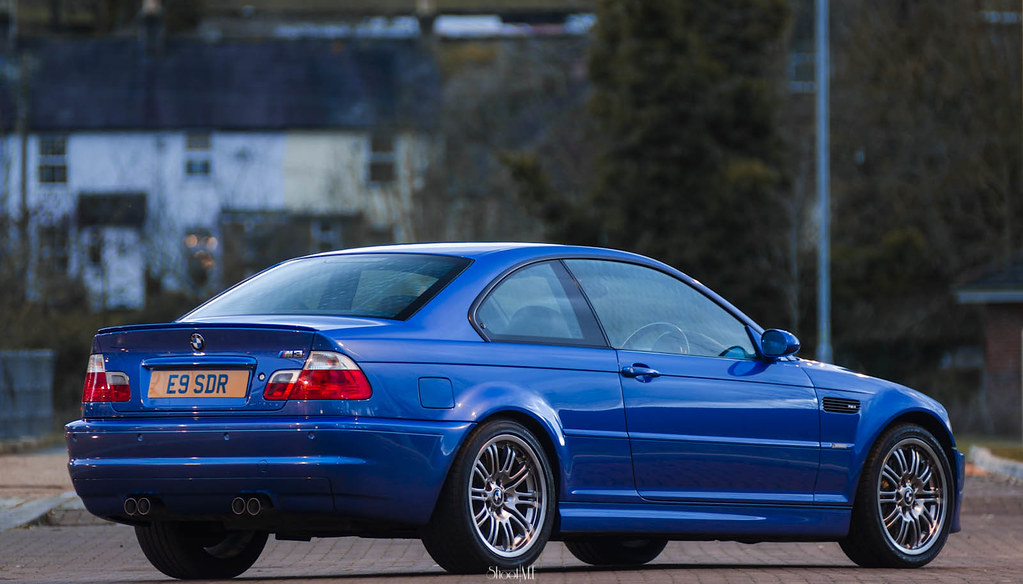
The E46 M3 and the S54: A Straight-Six Masterpiece
Launched in 2000 for the 2001 model year, the E46 M3 was the culmination of a lineage that began with the homologation-special E30 M3. Where that car was a boxflared touring-car racer for the road, the E46 M3 was something different: a grand, muscular, endlessly usable performance coupe that happened to be one of the most thrilling driver's cars of its generation.
The S54B32 Engine
At its heart was the S54B32 — a 3.2-liter naturally aspirated inline-six that stands as one of the finest engines BMW's M division has ever produced. Individual throttle bodies, a high-flow head, forged internals, and Double VANOS combined to produce roughly 333 hp (338 PS) at a screaming 7,900 rpm, with a redline of 8,000 rpm. Its specific output of over 100 hp per liter was extraordinary for a normally aspirated production engine of the era, and the sound — a hard, metallic wail building to a frenzy at the top of the tach — remains iconic.
The same S54 architecture powered the Z8's sibling applications and the Z3 M variants of the period, cementing its status as a millennium-defining M engine.
SMG II and the Manual
The E46 M3 was offered with a six-speed manual — the connoisseur's choice and the reason values of clean stick cars have climbed steeply — or the SMG II single-clutch automated manual, an early paddle-shift system that was cutting-edge at launch but has aged less gracefully than the pure manual. The debate over which is the true M3 experience continues, and it feeds directly into the broader conversation about the vanishing manual gearbox, which we explore in our feature on the future of manual BMW M cars.
The CSL: The Ultimate E46
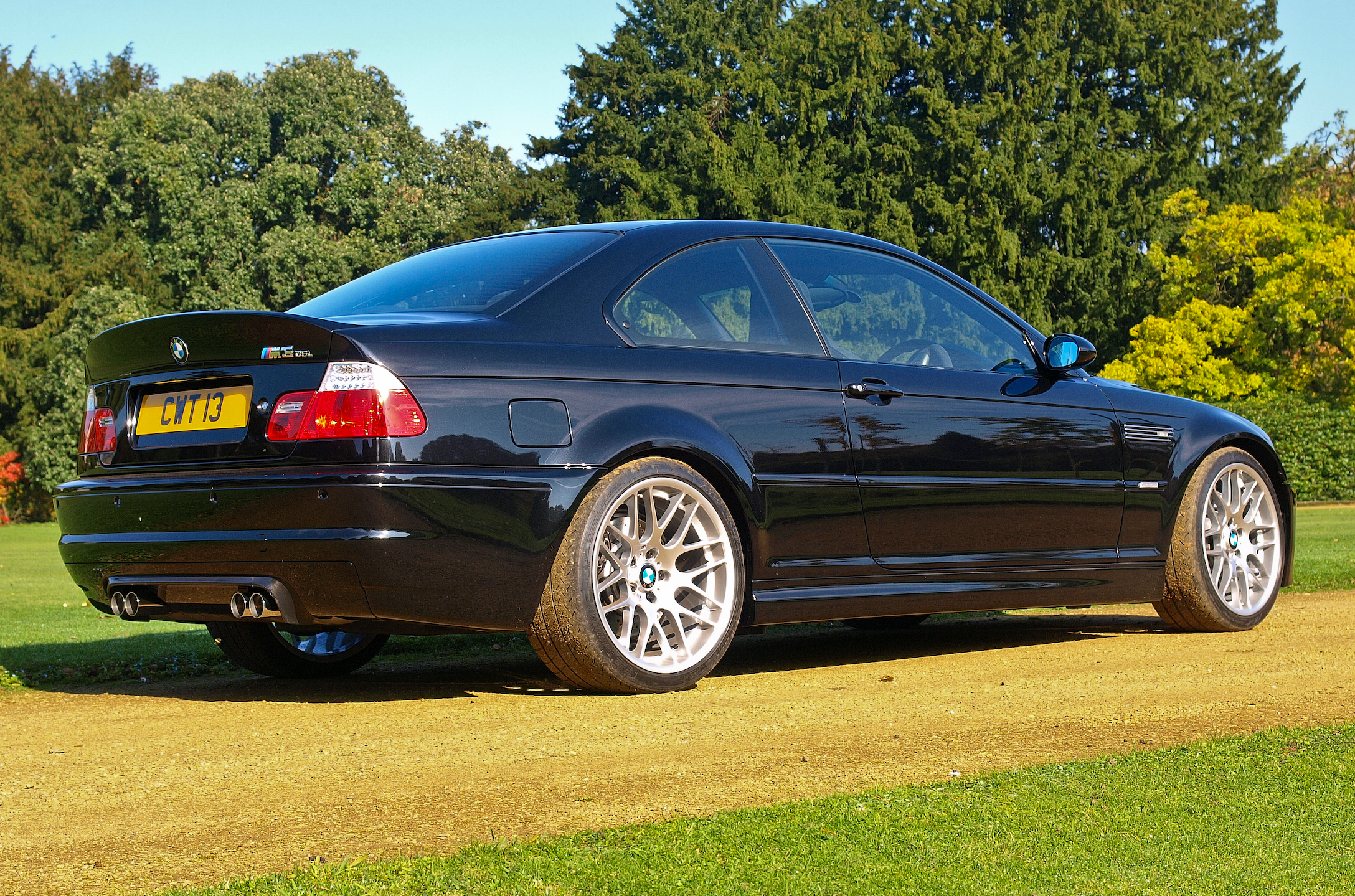
In 2003, BMW built the M3 CSL (Coupe Sport Leichtbau) — a lightweight homage to the legendary 3.0 CSL. It featured a carbon-fiber roof, a distinctive carbon airbox with a raucous intake bark, thinner glass, stripped interior appointments, and a modest power bump to around 355 hp. Sold only with SMG and produced in strictly limited numbers (roughly 1,383 units), the CSL is today one of the most coveted modern BMWs, a genuine future classic that trades for multiples of a standard M3.
Motorsport and Cultural Impact
The E46 platform carried BMW's racing banner across multiple disciplines. The M3 GTR, developed for the American Le Mans Series in 2001, controversially deployed a P60 V8 engine and forced a homologation controversy that led BMW to build a tiny run of road-going V8 M3 GTRs — among the rarest and most valuable BMWs ever produced. The M3 also competed extensively in touring car and endurance racing, and became a fixture of club motorsport, track days, and drift culture worldwide.
Culturally, the E46 achieved something few cars manage: it became simultaneously an aspirational hero car for a generation of enthusiasts and an accessible entry point into BMW ownership. The 330i and 325i became beloved daily drivers, while the M3 became a poster car. As values of clean examples now climb, the E46 has completed its transition from used car to modern classic — a journey shaped by exactly the kind of desirability metrics we track across the market, including the depreciation dynamics discussed in our analysis of modern BMW values.
The Legacy: Why the E46 Still Matters
The E46 sits at a precise inflection point in BMW's history. It was the last 3 Series to combine hydraulic power steering — with its rich, communicative feedback — with naturally aspirated engines and a relatively modest curb weight. The E90 that followed grew larger and heavier; the F30 introduced electric power steering and turbocharging as standard; and every generation since has piled on mass, screens, and electronic mediation.
The Analog High-Water Mark
This is why the phrase "best 3 Series ever made" attaches so persistently to the E46. It represents the maximum of what the analog sports sedan could be before the industry's priorities shifted decisively toward efficiency, connectivity, and electrification. The steering talks to you. The engine rewards revs rather than boost. The chassis feels alive in a way modern electronic architectures work hard to simulate. For drivers who prize interaction above outright numbers, the E46 — and especially the M3 — is close to perfect.
That character stands in sharp contrast to where BMW is headed. The turbocharged S58-powered G80 M3 makes the E46 look almost quaint on paper, yet many drivers still prefer the older car's directness. And as BMW pivots toward its electric future — from the i3 and i8 to the Neue Klasse revolution of 2026 — the E46 has become a touchstone, the reference point against which the brand's engineering soul is measured. The forthcoming i3 sedan as a possible future 3 Series only sharpens the nostalgia for what the E46 represented.
Collecting and Ownership Today
The E46 market has stratified. Ordinary 320i and 318i cars remain affordable transport, but clean manual 330i coupes, well-maintained M3 six-speeds, and above all the CSL have entered genuine appreciation territory. Enthusiasts researching a specific car should verify factory equipment through the option code database and confirm build details via the VIN decoder — original specification, documented rod-bearing service, and clean structural history now command significant premiums.
More than a quarter-century after its debut, the E46 endures not as a period piece but as a living argument about what makes a great driver's car. It is the sports sedan at its most complete — quick enough, refined enough, and above all involving enough to justify the enthusiast's oldest claim: that this, of all the 3 Series, is the one that got everything right.