For thirty-three years, one truth had governed the BMW M3. From the boxy E30 that homologated a touring-car legend to the howling V8 of the E90, the M3 had always sent its power to the rear wheels — full stop. It was doctrine. It was religion. The M3 was the purist's tool, a rear-drive scalpel that demanded skill and rewarded commitment. To suggest otherwise was heresy.
Then, in September 2020, BMW M unveiled the sixth-generation M3 — chassis code G80 — and the seventh-generation M4 Coupé, the G82. Beneath their controversially proportioned kidney grilles beat a new heart: the S58 twin-turbocharged inline-six, an engine that would define the entire M performance range for the decade to come. And for the first time in the model's history, buyers could option a genuinely transformative technology — M xDrive, an intelligent, rear-biased all-wheel-drive system that made the M3 faster, more usable, and more all-weather capable than any before it.
The reaction was seismic. The grille sparked internet wars; the arrival of AWD sparked existential debate. But strip away the noise and the truth emerges: the S58 era represents one of the most significant technical leaps in the M3's lineage — a car that finally reconciled savage performance with everyday reality, without abandoning the rear-drive soul that made it legendary.
The Context: An Icon Under Pressure
By the late 2010s, the compact super-sedan segment had become a proving ground for engineering escalation. The Mercedes-AMG C63 wielded a hand-built twin-turbo V8. Audi's RS models had long deployed quattro all-wheel drive to launch with contemptuous traction. Even within BMW's own house, the M5 had switched to M xDrive with the F90 generation in 2017 — and the sky had not fallen. If anything, that car proved AWD could be integrated without diluting M character.
The outgoing F80 M3, launched in 2014, had already made the leap from the naturally aspirated V8 of the E90 to a twin-turbocharged straight-six, the S55. That transition itself had been contentious — purists mourned the 8,300-rpm scream of the S65 V8 — but the S55 delivered a broad torque plateau and a return to the inline-six configuration that had defined M's greatest engines, from the M88 of the M1 to the S54 of the E46 M3.
BMW M faced a delicate problem heading into the G80 program. Emissions regulations were tightening. Performance expectations were climbing. And the customer base was splitting: track-day devotees wanted purity, while a growing majority wanted a car they could actually deploy in the wet, in the cold, on a Tuesday morning. The answer was not to choose — but to offer both.

The S58: A New Cornerstone Engine
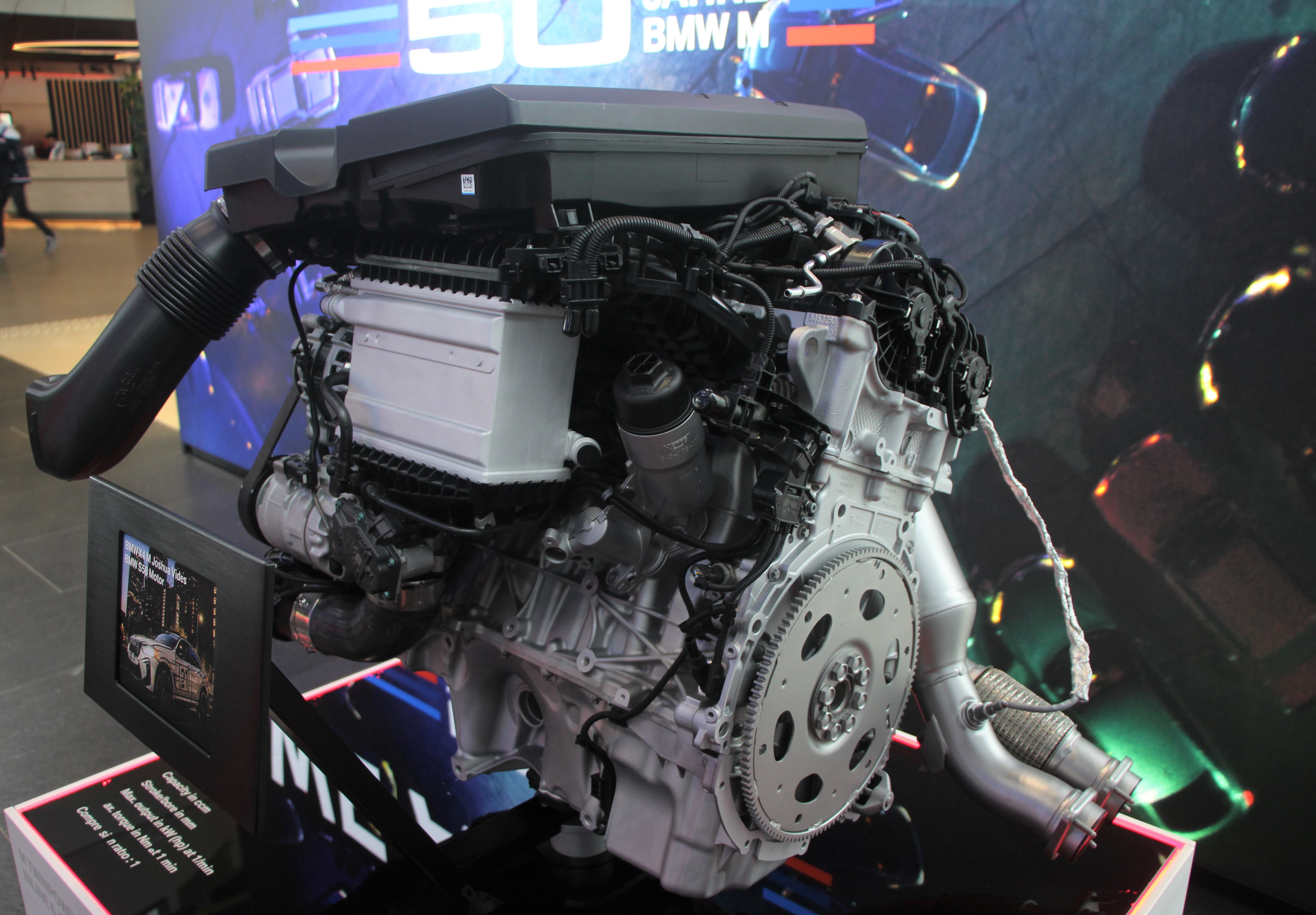
The S58 first appeared not in the M3, but in the 2019 X3 M and X4 M — a telling signal of BMW M's shift toward SUVs as volume drivers. But it was in the G80 and G82 that the engine found its definitive expression.
Internally designated S58B30, the engine displaces 2,993 cc and is based architecturally on the B58 mass-production straight-six — one of the finest engines BMW currently builds — but subjected to extensive M-specific reengineering. It features a closed-deck block for greater rigidity under boost, a 3D-printed cylinder head core (a manufacturing first that allowed complex internal coolant passages impossible with conventional casting), and two mono-scroll turbochargers rather than a single twin-scroll unit, each feeding three cylinders.
The engine represents an evolution of a philosophy that stretches back to VANOS variable valve timing, which BMW pioneered in 1992 and which remains fundamental to every M engine's ability to reconcile low-end tractability with high-rpm ferocity.
Power Outputs by Variant
| Variant | Power | Torque | 0–60 mph |
|---|---|---|---|
| M3 (base, manual) | 473 hp | 406 lb-ft | ~4.1 s |
| M3 Competition (RWD) | 503 hp | 479 lb-ft | ~3.8 s |
| M3 Competition xDrive | 503 hp | 479 lb-ft | ~3.4 s |
| M3 CS (2023) | 543 hp | 479 lb-ft | ~3.2 s |
The base M3 and M4, offered exclusively with a six-speed manual gearbox, produced 473 hp and 406 lb-ft. The Competition models, paired with a ZF eight-speed torque-converter automatic (replacing the dual-clutch of the F80 generation), delivered 503 hp and 479 lb-ft. Redline sits at 7,200 rpm — lower than the old atmospheric engines but generous for a modern turbo unit — and the S58 pulls with a relentless, muscular linearity that flatters even mediocre drivers.
M xDrive: The Heresy That Made Sense
The headline story of the S58 era is not merely the engine — it is M xDrive, the all-wheel-drive system that arrived on the M3 and M4 for the very first time in the model's history. To understand why it mattered, you have to understand how BMW engineered it.
M xDrive is not a conventional, front-biased AWD system grafted onto a rear-drive car. It is fundamentally rear-drive in character, sending torque forward only when the rear axle can no longer deploy it. At its heart is an electronically controlled multi-plate clutch that distributes drive to the front axle, working in concert with the Active M Differential at the rear. The system reads throttle, steering angle, yaw, and wheel speed hundreds of times per second.
Three Modes, One Philosophy
Crucially, BMW gave the driver control over the system's behavior through a dedicated setup menu offering three configurations:
- 4WD: Full stability, maximum traction — for wet roads, cold starts, and blistering launch-control acceleration.
- 4WD Sport: A more rearward torque bias that permits controlled slip and playful cornering attitude while retaining a safety net.
- 2WD: With DSC fully disabled, the system decouples the front axle entirely, transforming the M3 into a pure, unfiltered rear-drive machine — smoke-and-all — for the track.
This was the genius of the solution. Where the F90 M5 had pioneered M xDrive as a super-sedan feature, the G80 M3 democratized the philosophy and, critically, preserved the option of pure rear drive at the flick of a menu. The car could be a docile all-weather commuter or a tail-happy drift machine — the driver decided.
Chassis, Body, and the Grille Heard Around the World
The G80/G82 platform is a heavily reworked evolution of BMW's CLAR (cluster architecture) rear-drive structure, shared in principle with the 3 Series and 4 Series but stiffened extensively for M duty. BMW added a bolt-in front strut brace, a substantial engine-compartment cross-brace, and reinforced rear-axle subframe mounting — the latter now bolted rigidly to the body without rubber isolation, transmitting steering and cornering forces with unfiltered precision.
Track widths grew, the wheelbase stretched slightly over the F80, and the suspension employed adaptive M dampers as standard with revised geometry. The Competition models rode on staggered wheels — 19-inch front, 20-inch rear — wrapped in Michelin Pilot Sport 4S rubber. Optional carbon-ceramic brakes, a carbon-fibre roof, and lightweight carbon bucket seats (with their distinctive raised center cushion) rounded out the track-focused hardware.
And then there was the grille. The enormous vertical kidney grille — a deliberate homage, BMW insisted, to the tall grilles of the 328 and the pre-war 2000 CS — provoked more controversy than any styling decision in the marque's modern history. Where the 1936 328 wore its kidneys with delicate elegance, the G80 wore them like a statement of defiance. Time has softened the reaction; the design now reads as a bold, era-defining choice rather than a misstep.
The Model Family: M3, M4, Touring, and CS
The S58 era spawned the broadest M3/M4 family ever produced. Beyond the G80 sedan and G82 coupé, BMW added the G83 M4 Convertible and — to enormous enthusiast delight — the first-ever M3 Touring wagon, built on a variant of the G81 chassis and offered exclusively with M xDrive and the Competition powertrain. For decades, fans had begged BMW M for a fast estate; the S58 generation finally delivered it.
In 2023, BMW released the M3 CS, a lightweight, sharpened special with 543 hp, standard M xDrive, carbon-ceramic brakes, and a reduced kerb weight thanks to extensive carbon-fibre reinforcement. The M4 CSL — a coupé-only, rear-drive, two-seat homage to the E46 M3 CSL — pushed further still with 543 hp, aggressive aerodynamics, and a stripped interior, becoming the halo of the range.
Decoding Your G80: Chassis and Options
The proliferation of variants makes the S58 generation a fascinating case study for collectors and buyers. Each configuration — manual versus automatic, RWD versus xDrive, standard versus Competition versus CS — carries meaningfully different values and driving characters. To untangle the chassis codes, engine specifications, and equipment of any G80-generation car, our BMW DNA encyclopedia details the full lineage, while the Code Vault decodes the option packages that separate a well-specified example from an ordinary one. To verify the exact build of a specific car, run its number through our VIN decoder.
Cultural and Motorsport Impact
The S58 engine's significance extends far beyond the road cars. In lightly modified form, the unit powers the BMW M4 GT3 and GT4 race cars that compete globally — a modern echo of the homologation heritage that the E30 M3 established in 1986. Where the E30's S14 four-cylinder was born explicitly to satisfy Group A touring-car rules, the S58 was designed from the outset to serve both showroom and grid, its 3D-printed head and closed-deck block engineered for the thermal loads of endurance racing.
The M4 GT3 replaced the outgoing M6 GT3 as BMW's flagship customer racer, campaigning at the Nürburgring 24 Hours, the IMSA series, and countless national championships. That a road-car engine could underpin a professional GT3 program with only turbocharger and cooling modifications speaks to the S58's fundamental robustness — and continues the tradition of racing relevance that has defined BMW M since the division's founding in 1972.
Culturally, the G80 became a lightning rod. It divided the enthusiast community as few BMWs ever have — celebrated for its blistering capability and versatility, criticized for its styling and its embrace of automatic transmissions and all-wheel drive. Yet sales figures told an unambiguous story: the S58-powered M3 and M4 sold in strong numbers, with the M3 Competition xDrive and the M3 Touring proving especially popular in Europe. BMW M had read its customers correctly.
The Legacy: A Blueprint for the Modern M
The S58 is now the backbone of BMW M's combustion lineup. It powers the M2 (G87), the M3 and M4, the X3 M and X4 M, and continues to evolve with each application. It represents the culmination of a philosophy that began when BMW first turbocharged an M engine with the S55 — a philosophy of broad, deployable, all-weather performance.
More profoundly, M xDrive redefined what the M3 could be. The rear-drive purist's dream survives — the 473-hp manual car exists precisely for that customer — but the model's center of gravity shifted. The M3 became a car you could genuinely exploit in any condition, launching from a standstill with the ferocity that once belonged only to the AWD Germans of Ingolstadt and Affalterbach. In doing so, BMW M answered the challenge that had shaped the entire super-sedan arms race.
As BMW pivots toward electrification — a journey that began with the i3 and i8 and accelerates with the Neue Klasse generation — the S58 stands as arguably the finest internal-combustion engine the M division ever produced. It may well be remembered as the last great flowering of the turbocharged straight-six, a configuration that traces its DNA through the S54, the M88, and every legendary six that came before. When the combustion M car finally gives way to electric power, the S58 era will be the high-water mark against which the future is measured.