In March 2022, two threads of BMW's story that had run in parallel for more than half a century finally converged. On one side stood ALPINA — the Buchloe-based house that had spent five decades transforming BMWs into something quieter, faster, and more exquisitely finished than Munich itself dared to build. On the other stood the iX, a bulbous, controversial, technologically dense electric flagship that carried BMW's fifth-generation eDrive powertrain and pointed unmistakably toward a battery-driven future. That both events belonged to the same twelve months was no accident. It was a company deciding, all at once, what it wanted to preserve and what it wanted to become.
The ALPINA announcement landed like a thunderclap in enthusiast circles. For decades ALPINA had occupied a peculiar legal and cultural space: not a tuner, but a recognized automobile manufacturer in its own right, building fewer than 2,000 cars a year with a craftsman's obsession and a badge every bit as revered as BMW's own roundel. BMW confirmed it had reached agreement to acquire the ALPINA brand rights, with the transition to be completed and independent ALPINA vehicle production ending by the close of 2025. The family would continue — Andreas and Florian Bovensiepen retained the automotive business under a services arrangement — but the trademark, the future, and the direction now belonged to Munich.
The iX, meanwhile, was BMW's statement of intent made metal. Where the i3 and i8 of 2014 had been experimental outliers — carbon-fibre curiosities that tested the market's appetite — the iX was a full-size, series-production luxury SUV engineered from the ground up as an electric vehicle. It marked the debut of eDrive generation five and delivered, at last, the range figure BMW's earlier electric cars had always lacked. Together, ALPINA and the iX defined 2022 as the year BMW reconciled its past with its future.
The Historical Context: A Brand at a Crossroads
To understand 2022, you have to understand the pressure BMW faced entering the decade. The European Union's tightening CO2 fleet regulations, the accelerating collapse of diesel demand after the industry-wide emissions scandal, and the arrival of aggressive electric competition from Tesla and a wave of new entrants had all forced Munich into a strategic reckoning. BMW's answer was not the wholesale abandonment of combustion that some rivals promised, but a deliberate hedging: continue refining internal-combustion excellence — the S58-powered G80 M3 had arrived only three years earlier — while building a parallel electric architecture capable of scaling across the entire range.
ALPINA's position in this landscape was precarious. The company's business model depended on modifying BMW's combustion platforms — extracting extraordinary refinement and torque from the twin-turbo V8s and inline-sixes it re-engineered. As BMW pivoted toward electrification, the runway for that model was closing. An electric future left little room for an independent house whose entire craft was the perfection of the internal-combustion BMW. Rather than let a treasured name fade into irrelevance, BMW chose to bring it home.
Who — and What — Was ALPINA?
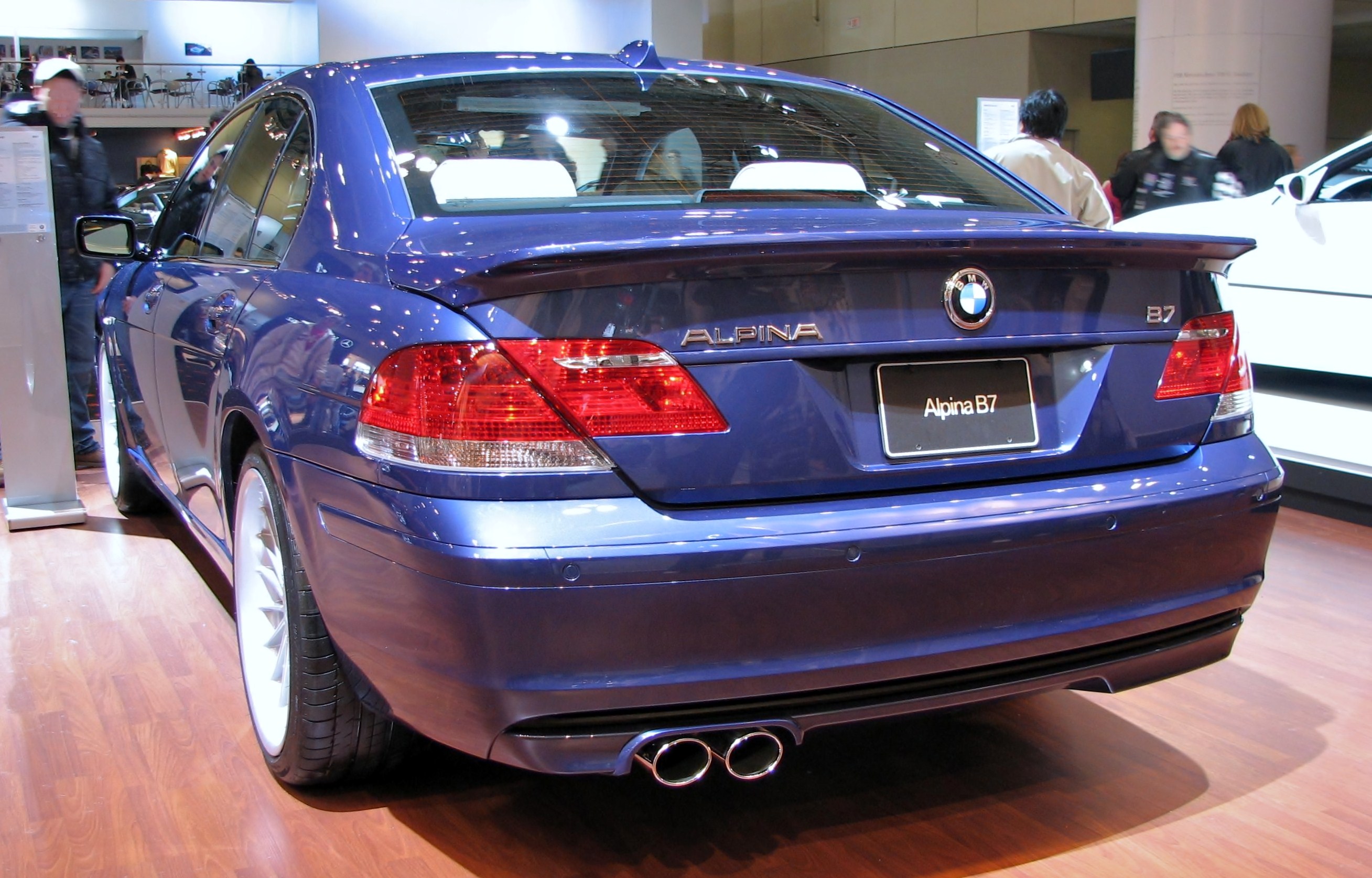
Burkard Bovensiepen founded ALPINA Burkard Bovensiepen KG in 1965, initially producing Weber carburettor kits for the Neue Klasse sedans that had saved BMW earlier that decade. BMW itself blessed the operation early, honoring warranties on ALPINA-modified cars — an extraordinary vote of confidence. Over the following decades ALPINA built a reputation on cars like the B7, B10, and later the B7 and XB7, machines that prized effortless high-speed cruising, hand-finished interiors, the signature 20-spoke wheels, deep Alpina Blue and Alpina Green paint, and gold pinstriping over the raw aggression of BMW's own M division. Where M chased the apex, ALPINA chased the horizon.
The iX: Fifth-Generation eDrive Arrives
If ALPINA represented what BMW wanted to preserve, the iX embodied what it wanted to build. Internally designated the I20, the iX arrived in late 2021 and reached full global rollout through 2022 as the technological flagship of BMW's electric line-up. It was the first BMW conceived around fifth-generation eDrive — the powertrain family that would go on to underpin the i4, i7, and the electric variants filling out the range.
The Technology Underneath
The defining innovation of fifth-generation eDrive was integration. BMW packaged the electric motor, transmission, and power electronics into a single compact housing, and — crucially — adopted a current-excited synchronous motor (CESM) that required no rare-earth magnets. This was significant: it freed BMW from dependence on the rare-earth supply chain while delivering strong efficiency and consistent high-speed output. The battery cells used a high nickel content chemistry to lift energy density, and the whole system was engineered for the range figures BMW's earlier electric cars had never reached.
At launch the range spanned two principal variants. The iX xDrive50 paired dual motors for all-wheel drive, a usable battery capacity in the region of 105 kWh, combined output around 385 kW (roughly 516 hp), and a WLTP range that comfortably exceeded 600 km — translating to well over 300 miles on more conservative cycles. The performance flagship, the iX M60, pushed combined output beyond 455 kW in boost mode with monumental torque, dispatching 0–100 km/h in the low four-second range while retaining serious range. DC fast charging peaked around 195–200 kW, allowing a 10–80% replenishment in roughly 35 minutes under ideal conditions.
| Specification | iX xDrive50 (I20) | iX M60 (I20) |
|---|---|---|
| Powertrain | Dual motor, xDrive AWD | Dual motor, xDrive AWD |
| Peak output | ~516 hp (385 kW) | ~610 hp (455 kW, boost) |
| Usable battery | ~105 kWh | ~105 kWh |
| 0–100 km/h | ~4.6 s | ~3.8 s |
| WLTP range | up to ~630 km | up to ~566 km |
| Max DC charging | ~195 kW | ~195 kW |
| Motor type | Rare-earth-free CESM | Rare-earth-free CESM |
Specifications varied by market and model year; figures above are drawn from BMW's published data and should be treated as representative ranges.
Structure, Design, and Interface
Beneath the divisive bodywork lay a genuinely novel structure BMW called the Aluminium Space Frame with a carbon-fibre-reinforced plastic (CFRP) cage — the "Carbon Cage" — integrated into the passenger cell for stiffness without weight penalty. It was, in a sense, the lesson of the i3's carbon construction scaled up and matured for a two-tonne luxury SUV. The oversized kidney grille, sealed and housing sensors rather than cooling an engine, drew furious debate, but it signalled a deliberate break from combustion-era design language.
Inside, the iX introduced BMW's curved display — a single glass panel merging the instrument cluster and central touchscreen — running iDrive 8 built on BMW Operating System 8. It was the most significant leap in the interface since iDrive first debuted on the E65 7 Series in 2001, trading the rotary-first philosophy of that era for a screen-forward, voice-and-touch experience. That evolutionary line continues today; readers curious about where it leads should see our guide to iDrive 9 and the next-generation iX3.

ALPINA Meets the Electric Age
The irony of 2022 was not lost on anyone: BMW acquired a marque built entirely on internal-combustion refinement at the precise moment the company was betting its future on electrification. What, exactly, would ALPINA become under BMW ownership?
The answer, as it emerged, was a repositioning rather than a resurrection of the old formula. BMW signalled that ALPINA would occupy a distinct niche above the standard range and adjacent to M — a house of luxury, long-distance refinement, and bespoke craftsmanship, rather than a second performance division competing with M on the track. Where M would remain the razor's edge, ALPINA would be the velvet glove: the choice for the buyer who wanted extraordinary capability delivered with the quietest, most cultured possible manners.
Independent ALPINA production of combustion cars was set to wind down by the end of 2025, with the final Buchloe-built B-series models becoming instant collector pieces. The XB7 — an ALPINA take on the X7 with a heavily reworked twin-turbo V8 — and the B8 Gran Coupé stand among the last of a lineage that stretches back to the carburettor kits of the 1960s. For enthusiasts weighing these cars, understanding the powertrains they were built on matters; those V8 platforms carry their own maintenance considerations, as we explore in our guide to preventing BMW V8 oil leaks.
Decoding the Cars
Both ALPINA and iX models carry the layered identity codes that define every modern BMW — chassis designations, engine families, and option packages that tell the full story of a given car. You can trace the I20 iX platform and its predecessors, or the BMW chassis on which ALPINA built its final generation, through our BMW DNA chassis and engine encyclopedia. The bespoke equipment and paint that distinguished an ALPINA from its donor car can be cross-referenced in the Code Vault option-code database, and any specific example's build can be verified with the VIN decoder.
Cultural Impact and the Enthusiast Reckoning
The twin events of 2022 provoked genuine soul-searching among BMW's faithful. The ALPINA acquisition was met with a mixture of relief and apprehension — relief that a beloved name would survive, apprehension that BMW might dilute the very independence that made ALPINA special. The magic of an ALPINA had always come from a small team in Buchloe doing things BMW's own volume constraints would never permit: individually numbered plaques, Lavalina leather stitched by hand, that unmistakable ride quality tuned over thousands of autobahn kilometres. Whether a corporate ALPINA could preserve that soul remained, in 2022, an open question.
The iX drew even sharper reactions, and they had little to do with its engineering. The car's styling — particularly that enormous sealed grille — became a lightning rod. Yet beneath the controversy, the iX quietly did exactly what BMW needed: it proved the company could build a desirable, genuinely long-range electric luxury vehicle, and it validated fifth-generation eDrive as the foundation for everything to come. It also raised the questions every EV buyer now confronts around residual values — a subject we examine in detail in our analysis of BMW EV depreciation across the i4, iX, and i7.
The Legacy: How 2022 Echoes in Today's BMWs
The significance of 2022 becomes clearer with every passing model year. Fifth-generation eDrive proved to be a bridge technology — a proof of concept that BMW would refine and then supersede. Its true successor is the sixth-generation eDrive and the Gen6 800-volt architecture that underpins the Neue Klasse, the platform that arrives in force with the 2026 Neue Klasse revolution. The iX was, in retrospect, the last great statement of BMW's transitional EV era before that clean-sheet reinvention. To understand how radically the design language would shift afterward, read our feature on how the Neue Klasse redefines BMW design.
The name itself, of course, carries enormous weight. When BMW invoked "Neue Klasse" for its next generation, it deliberately reached back to the 1962 sedans that saved the company from bankruptcy and gave rise to the 02 series and the entire sports-sedan tradition that followed. The iX of 2022 was the machine that made that revolution possible — the workhorse that carried BMW across the threshold.
ALPINA's legacy, meanwhile, is still being written. The final independent Buchloe cars have become blue-chip collectibles, prized precisely because they represent the end of an era. Whether the ALPINA badge under BMW ownership recaptures the hand-built magic of old, or evolves into something new, the marque's survival ensures that a distinct philosophy — luxury and refinement over outright aggression — remains alive in the BMW family. As the combustion era draws toward its close and enthusiasts debate whether cars like the G87 M2 mark the last of the manual M cars, ALPINA's re-absorption feels less like an ending and more like a careful act of preservation.
2022, then, was a year of reconciliation. In bringing ALPINA home and launching the iX in the same breath, BMW declared that it could honour its past and reinvent its future simultaneously — that the same company which perfected the internal-combustion inline-six could build a rare-earth-free electric flagship, and that both traditions deserved a place in what came next. It was, in every sense, a hinge in the marque's long history.